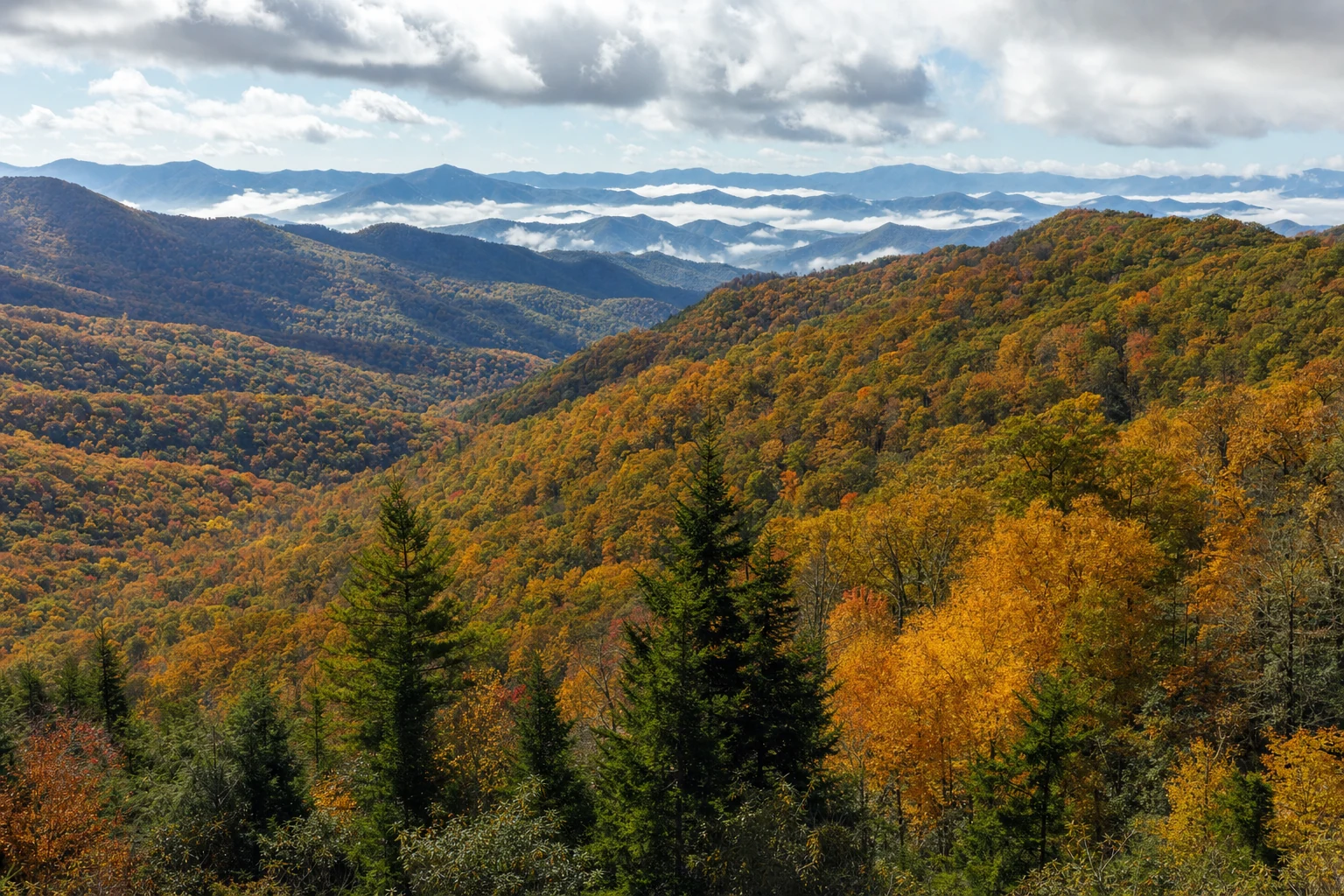

The food of the Smokies is Appalachian resourcefulness translated into flavor — a cuisine shaped by remote hollows, long winters, salt-cured hogs, corn whiskey, and apple orchards that stretched from ridge to ridge. The modern tourism layer of pancake houses, barbecue pits, and themed distilleries sits on top of a much older foundation: mountain families preserving what they could, cooking what they had, and passing recipes down through generations. Understanding that foundation is what separates a tourist meal from an actual taste of the Smokies.
The Southern breakfast foundation
The Smokies breakfast is not a light affair. It is a working-person's meal, engineered to carry a mountain family through hard physical labor, and the tradition carries forward largely intact.
- Country ham — cured for months with salt and sugar, served in thin slices pan-fried until the edges crisp. The defining accompaniment is red-eye gravy, a thin sauce made from the pan drippings deglazed with black coffee. It is an aggressively salty, aggressively flavorful plate that speaks to an era when every part of the hog mattered.
- Biscuits and sawmill gravy — the biscuits are flaky, made with lard or shortening to old family templates. The gravy is built from sausage drippings, flour, milk, and aggressive black pepper. Simple, complete, and unchanged in a hundred years.
- Stone-ground grits — not the instant supermarket version. Stone-ground grits hold onto the corn's flavor and require long cooking, yielding a creamy texture that pairs with butter, cheese, or country ham. Local mills still produce them.
- Wildflower honey and sorghum syrup — honey reflects the diverse Appalachian flora, while sorghum delivers a molasses-like sweetness distinct to the region. Both end up drizzled on biscuits, pancakes, or stirred into coffee.
- Apple butter — a thick, spiced spread made by slow-cooking apples in large copper kettles over open fire. The "apple butter makin'" was historically a community event tied to the autumn harvest and still appears at harvest festivals today.
How Gatlinburg became pancake country
Gatlinburg's identity as the pancake capital traces to a specific place and date: the Pancake Pantry, opened by Robert and Juanita Ehlers in 1960, the first pancake house in Tennessee. The timing was not accidental. Great Smoky Mountains National Park was drawing an escalating wave of post-war family vacationers, and breakfast — a meal families eat together, away from the hotel room — was an open category. The Pantry's menu went far beyond flapjacks: crepes, specialty waffles, a long list of fruited and chocolate variations. It created a template.
Within a decade, imitators filled downtown Gatlinburg, and the region developed a critical mass of pancake operations that now exceeds anywhere else in the country. Pigeon Forge followed with its own dense cluster. The economic logic survives: pancakes scale cheaply, families universally like them, and the format accommodates the region's long breakfast service window. First-timers still queue at the original Pancake Pantry; the line often forms well before opening.
Moonshine — from stills to storefronts
The moonshine history of the Smokies is a genuine cultural artifact, not a marketing invention. Appalachian hollows — remote, heavily forested, and well-watered — were ideal for illicit distillation through Prohibition and long after. Scotch-Irish settlers brought distilling traditions with them. Corn was plentiful. Transportation options were limited for raw crops. Converting corn to whiskey solved an economic problem. "White lightning" was produced under moonlight to avoid revenuers, stills hidden in the woods with escape paths mapped in advance. The folklore — daring runners, federal raids, family grudges — is mostly true in outline.
The legal revival is recent. Ole Smoky Moonshine opened in Gatlinburg in 2010 as Tennessee's first legal moonshine distillery. It bet on tourist interest in the heritage and won decisively. Sugarlands Distilling Co. followed in Gatlinburg in 2014. Both operate on the parkway with tasting flights, tours, and broad ranges of flavored moonshines — apple pie, blackberry, cherry, traditional corn. The product is legal; the storytelling is authentic; the distilleries are now among the highest-traffic stops in town. They have done more to preserve and share the moonshine story than any museum could.
Apple country and the Apple Barn complex
Apples shaped the economy of the Tennessee foothills for generations, and the Applewood Farmhouse Restaurant in Sevierville, opened in 1986, is the definitive apple-forward dining experience. Every meal opens with a complimentary serving of warm apple fritters and homemade apple butter. The menu threads apples throughout — pork chops with apple chutney, apple cobbler, apple-glazed entrees — but the restaurant is also a full Southern comfort-food destination: fried chicken, country ham, roast beef.
The restaurant is part of the Applewood Farmhouse Village, which also includes the Apple Barn Cider Mill & General Store and the Apple Barn Winery. Visitors watch apples pressed into cider, sample apple wines, buy fresh fruit from the orchards, and take home pies, turnovers, and apple-themed goods. The complex functions as a living showcase of the region's apple heritage — orchard, mill, kitchen, and market all in one place. The fritters alone are worth the detour for anyone passing through Sevierville.
Barbecue between Tennessee and Carolina
The Smokies sit geographically between Tennessee's pork-forward, dry-rubbed tradition and the two distinct Carolina styles — eastern Carolina's whole-hog, vinegar-and-pepper approach and western (Lexington) Carolina's ketchup-and-vinegar sauces. The region's restaurants blur the lines, which is part of the appeal.
- Bennett's Pit Bar-B-Que in Gatlinburg slow-smokes over hickory, serving ribs, pulled pork, chicken, and brisket with sauces on the side. The style leans Tennessee — dry-rubbed meat, sauce as accompaniment rather than the point.
- Mama's Farmhouse in Pigeon Forge runs family-style, served-to-your-table Southern platters. Fried chicken is the lead, but barbecue pork appears in rotation. The format is old-school all-you-can-eat with passed bowls.
- Smoky Mountain Brewery, with Gatlinburg and Pigeon Forge locations, is a pub rather than a barbecue joint but carries barbecue-inflected menu items — pulled pork sandwiches, barbecue pizzas — alongside the beer list.
The net effect is a region where smoked meat is pervasive rather than regimented. Purists will argue that the Smokies has no single barbecue identity of its own; travelers focused on eating well will find that the ambiguity works in their favor.
Trout from the streams to the plate
The park's waters are cold, clear, and full of trout. Two species dominate: the introduced Rainbow Trout, widespread and stocked in the larger streams, and the native Southern Appalachian Brook Trout, smaller, confined to higher-elevation headwaters, and the true prize for conservation-minded fly anglers. Fishing is regulated; licenses are required; some sections are catch-and-release only. Since March 2023, the Park-It-Forward program has required a parking tag for any vehicle parked more than 15 minutes anywhere in GSMNP — $5 daily, $15 weekly, $40 annual — and that includes trailheads used to reach the streams.
On the restaurant side, trout appears on menus throughout the region. Cherokee Grill & Steakhouse in Gatlinburg and The Peddler Steakhouse on River Road both feature rainbow trout, typically pan-fried or grilled simply to let the fish's delicate flavor carry the plate. The fresher the source, the better — and most operations source from cold local waters or nearby aquaculture, keeping the mountain-to-plate arc short.
Dolly Parton's cinnamon bread and the Dollywood food legacy
Dollywood is a theme park with a serious food program, and its anchor item is Dolly Parton's Cinnamon Bread, sold at the Grist Mill in Craftsman's Valley. The bread is a pull-apart loaf, rich with butter, cinnamon, and sugar, baked on site and served warm. The aroma draws crowds from across the park. The recipe has not been published in full. It has become the signature souvenir food of the region — plenty of visitors come to Dollywood specifically for the bread.
Beyond the cinnamon bread, the park's food program runs wide. Miss Lillian's Smokehouse handles barbecue, with ribs, pulled pork, and smoked chicken. Southern buffets, fried chicken, and homemade kettle corn appear across the park. Seasonal festivals drive the menu — the Harvest Festival in fall brings pumpkin-centric treats and heavy Southern comfort plates; Smoky Mountain Christmas shifts to hot chocolate, cocoa, and holiday breads. The program is one of the more coherent food operations in the theme-park industry, and it reflects Parton's own insistence on presenting her mountain heritage with dignity.
The North Carolina side — quieter, more traditional
Cross the ridge into North Carolina and the culinary scene thins out, slows down, and becomes more authentically rustic. Tourism is lighter on this side; the traditions are closer to the surface.
- Pisgah Inn Dining Room at Milepost 408 on the Blue Ridge Parkway is the signature NC-side experience. The dining room has full panoramic windows across the ridges. The menu is classic mountain comfort — fried chicken, mountain trout, country ham, seasonal vegetables — cooked simply, served generously. The isolation and the elevation are part of the draw.
- Historic Santeetlah Lodge near Robbinsville sits by Lake Santeetlah deep in the Nantahala region. The dining skews more refined — seasonal ingredients, regional specialties, attentive presentation — within a rustic lodge setting. Intimate rather than cavernous.
- Cherokee food traditions survive in and around Cherokee, NC, on lands of the Eastern Band of Cherokee Indians. Indigenous foodways feature corn, beans, squash, and wild game, prepared with methods that long predate European arrival. Local eateries occasionally feature traditional dishes, offering a direct link to the foodways of the region's original inhabitants.
The harvest festival and the fall calendar
The Smoky Mountains Harvest Festival runs mid-September through October and is when the region's food heritage is most visible. Gatlinburg, Pigeon Forge, and the surrounding towns fill with fall-themed menus, artisan vendors, and cooking demonstrations. Apple cider donuts, pumpkin desserts, hearty stews, sorghum samples, and apple butter kettles appear at festival grounds. Craft fairs move homemade preserves, jams, pickles, and baked goods alongside the food.
Dollywood's Harvest Festival is a full production inside the park — Southern Gospel Jubilee concerts alongside heavy fall menus. Many area restaurants run seasonal specials tied to the festival calendar. The combination of cooling weather, peak foliage in October, and the density of festival activity makes fall the strongest season to eat in the Smokies — the flavors match the landscape.