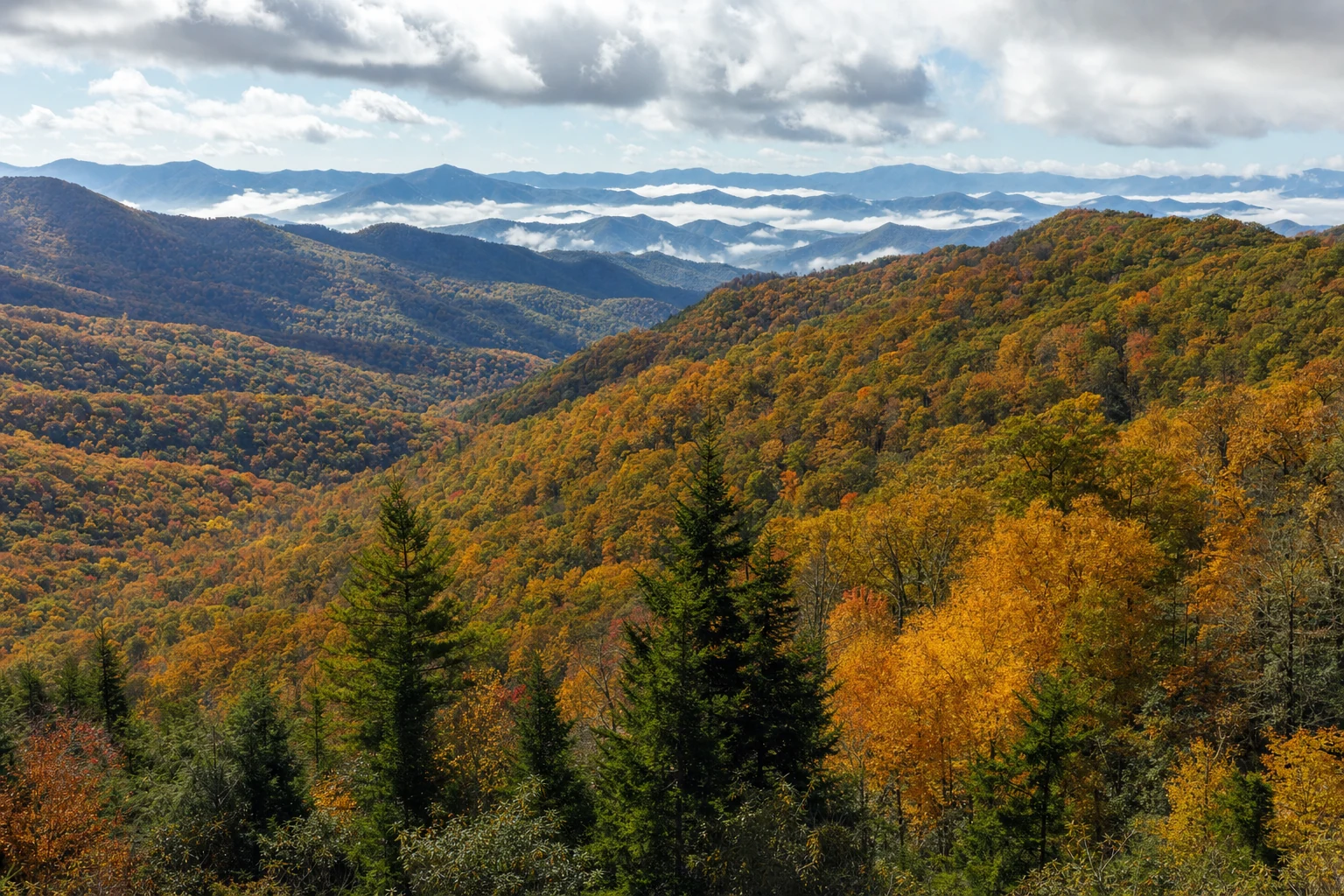

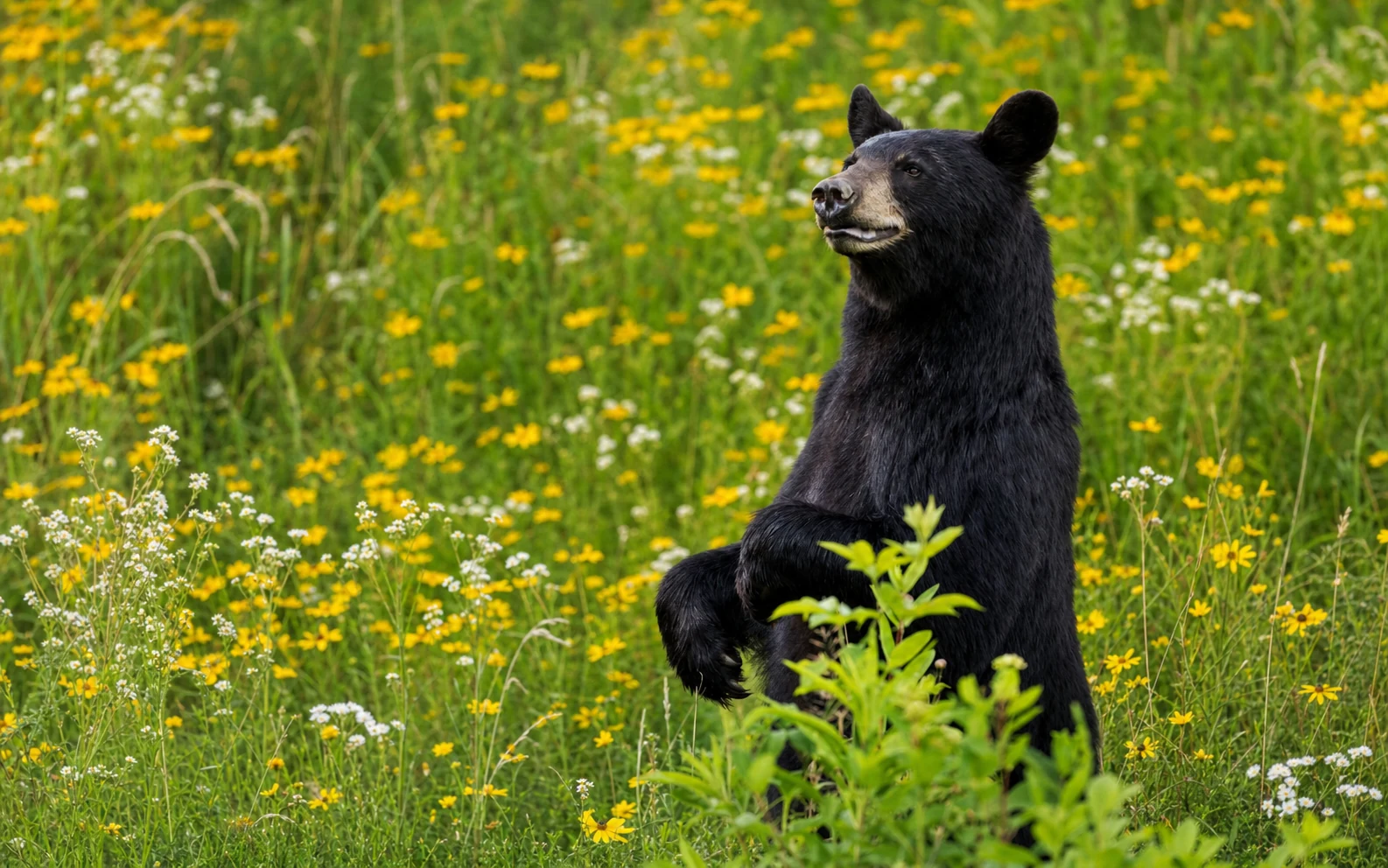
The best places to see wildlife in the Smokies are Cades Cove for black bears, deer and turkeys, and Cataloochee Valley and Oconaluftee for elk, in each case at dawn and dusk. Federal rules require you to stay at least 50 yards from bears and elk, and the best photograph is the one you take with a long lens from the car.
The park holds one of the most diverse ecosystems in temperate North America, with more than 19,000 documented species and scientists estimating many thousands more still undescribed. The headline cast is black bears, reintroduced elk, white-tailed deer, wild turkeys and, on a few cliffs, peregrine falcons. Everything is better from a respectful distance.
Where do you see black bears in the Smokies?
Population: roughly two bears per square mile, one of the densest black bear populations anywhere in the eastern United States.
Where to look: Cades Cove at dawn and dusk, especially spring and fall; the Roaring Fork Motor Nature Trail (open through November 29, 2026); and creek edges and meadow margins throughout the park.
When: Bears are most active from March through November, and much less active in winter (torpor, not true hibernation). May and June bring mating season and sows with cubs, and September and October bring heavy foraging on acorns.
The rules:
- Stay at least 50 yards (half a football field) away.
- Never approach for a photo. Use a telephoto lens or crop later.
- If a bear approaches, make yourself large, make noise and back away slowly. Do not run.
- If a bear charges, stand your ground (most charges are bluffs). Do not play dead.
- Report aggressive or food-conditioned bears to a ranger right away.
Food storage: keep food, coolers and scented items in your closed vehicle or the bear-proof boxes provided at campsites. Never leave food unattended at a campsite, picnic table or car hood. The full protocol is in the bear safety guide.
Where do you see elk in the Smokies?
Population: roughly 200 animals, reintroduced beginning in 2001 after about 150 years away.
Where to look: Cataloochee Valley on the northeast side of the park (the larger herd) and the Oconaluftee Valley next to the Oconaluftee Visitor Center near Cherokee, North Carolina. See the elk watching guide for access details.
When: Dawn and dusk year-round. The rut (breeding season) runs from mid-September through mid-October, with bulls bugling and sparring. Cows calve in late May and June and are at their most defensive then.
The rules:
- Stay at least 50 yards from elk, and much farther from bulls during the rut.
- Never approach on foot or turn your back on an elk that is aware of you.
- Do not feed wildlife, ever.
- Obey closures in elk fields during the rut and calving season.
What about deer, turkeys and other animals?
White-tailed deer are common at Cades Cove, with hundreds visible on a good evening. They are the easiest wildlife to photograph, but give them space. Fawns are born in May and June. Never touch a fawn, even one that looks abandoned. Mothers hide fawns while they feed and come back.
Wild turkeys are found in Cades Cove, Cataloochee and throughout the park, often in groups of six to twenty. Spring gobbling in April and May is loud and wonderful.
Salamanders: the Smokies are often called the salamander capital of the world, with 30 or more species. Most are small, cryptic and found in damp leaf litter or stream edges. Look, but do not collect.
Birds: more than 250 species have been documented. Spring warbler migration in April and May is excellent, and peregrine falcons nest on a few park cliffs. Barred owls, pileated woodpeckers and ruffed grouse are common.
What about the fireflies?
The synchronous fireflies of Elkmont flash in unison for about eight nights between late May and mid-June (2026: May 20 to 27), and access is by recreation.gov lottery each April. See the fireflies guide.
How do you photograph wildlife ethically?
- Use a long lens. 300mm at minimum, 500mm or more preferred, so you never need to get closer.
- Never bait or call in wildlife with food, sounds or recordings.
- Do not block traffic. Pull fully off the road when you stop for a sighting.
- Turn off your engine at pullouts while watching.
- Skip the flash at dawn and dusk. Natural light is more ethical and usually more beautiful.
More shooting advice is in the photography guide.
What is the wildlife calendar by month?
| Month | Highlight |
|---|---|
| January | Winter bird activity; Wilderness Wildlife Week in Pigeon Forge (Jan 4-7, 2027) |
| February | First bear emergence in low valleys; elk shed antlers around late winter |
| March | Bear activity picks up; wild turkey gobbling begins |
| April | Warbler migration; strong bear activity; wildflowers |
| May | Fawns born; sows with cubs; firefly lottery results and viewing begin late in the month |
| June | Synchronous fireflies (early June); elk calving |
| July | Everything active; dawn and dusk are best |
| August | Salamander breeding; late-summer bear fattening |
| September | Elk rut begins; bears feed on acorns |
| October | Peak elk rut; bear foraging intensifies before winter |
| November | Elk rut ends; bears slow down |
| December | Light wildlife activity; some bears in near-torpor |