
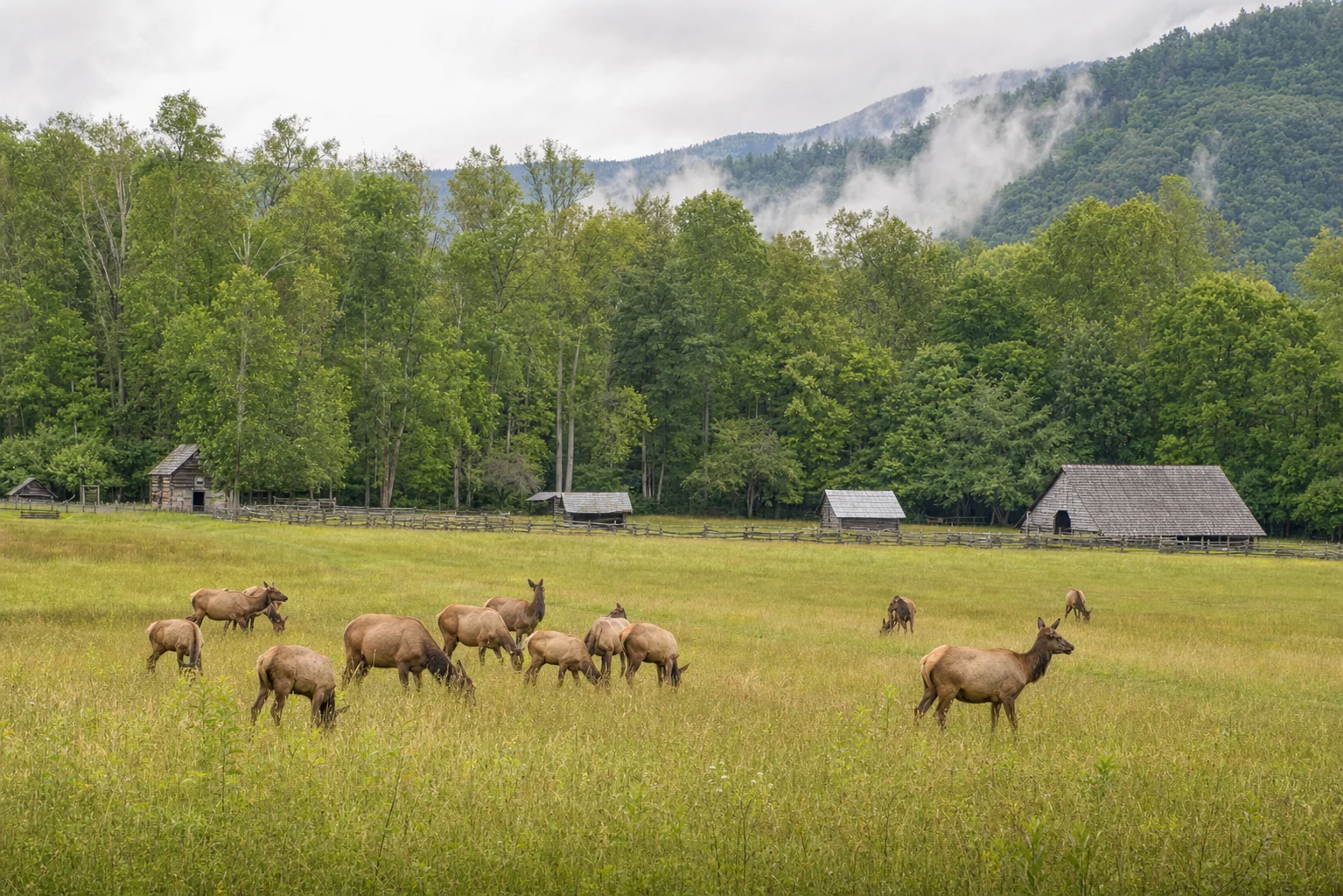
The best places to watch elk in the Smokies are Cataloochee Valley and the fields beside the Oconaluftee Visitor Center near Cherokee, North Carolina, at dawn or dusk. The fall rut, from mid-September through mid-October, is the peak show: bulls bugle, sparring clashes echo across the valley, and the herd gathers in open meadows. The law requires you to stay at least 50 yards away, and far more from bulls in the rut.
Elk (Cervus canadensis) were reintroduced to the park starting in 2001, after about 150 years away. Today roughly 200 live here, mostly in two ranges, and the herd is one of the park's great success stories. No timed entry or reservation is needed for either viewing area.
Where do you see elk in the Smokies?
Cataloochee Valley (northeast NC side): the larger herd and the more dramatic setting, with broad meadows ringed by old homesteads, a church and a schoolhouse. The usual route is from I-40 exit 20 near Waynesville, then a narrow, winding road (Cove Creek Road) of roughly 11 miles, part of it gravel. It is not suitable for RVs or trailers, and the Park Service lists Cataloochee Road as open year-round, weather permitting. Hurricane Helene damaged several Cataloochee-area trails, so check the NPS closures page before you go. See the Cataloochee guide.
Oconaluftee Valley (near Cherokee, NC): a more accessible herd. Elk graze the fields beside the Oconaluftee Visitor Center and Newfound Gap Road just north of Cherokee, and rangers and volunteers often staff the viewing area on busy fall weekends. It is a five-minute drive from town, and the Oconaluftee River Trail runs through the same valley. See the Cherokee guide.
When is the best time to see elk?
Dawn and dusk, year-round. Elk are crepuscular grazers, feeding most in the first hour after sunrise and the last before sunset. At midday they are usually bedded down at the tree line.
The rut: mid-September to mid-October. Bulls gather harems of cows, bugle constantly to claim territory, and fight rivals. The bugle is a rising whistle that ends in a grunting cough, and it carries across Cataloochee at first and last light. October weekends draw big crowds, so go on a weekday if you can.
Calving: late May and June. Cows hide newborn calves in tall grass. A cow with a calf is more defensive than a bull in the rut, so give her wide room.
Winter: elk stay in both valleys year-round, and a whole herd bedded in a frosty meadow at dawn is a sight in January. Bulls shed their antlers in late winter, and shed antlers are park property, so leave them where they lie.
What are the elk viewing rules?
Stay at least 50 yards away. Bulls weigh 700 to 1,100 pounds, run 30 miles an hour or more, and have charged people and vehicles. During the rut, 100 yards or more is safer.
Do not walk into the fields. Watch from the road edge or designated pullouts. Never get between a bull and his cows, or a cow and her calf.
Keep dogs out of it. Dogs can trigger a strong defensive response from elk. Pets are not allowed on park trails other than the Gatlinburg Trail and Oconaluftee River Trail, and they must always be leashed.
Keep your voice normal. Shouting, whistling or using bugle calls or recordings to attract elk is illegal and harmful.
Use a long lens. 300mm is the minimum and 500mm or more is better. No flash.
How do you plan a rut visit?
- Arrive before sunrise. Cataloochee is cold on a September morning, often 20 degrees cooler than Maggie Valley.
- Park along the valley road and watch from the road edge.
- Bring binoculars, a spotting scope if you have one, a warm jacket and a thermos.
- Plan to stay two hours or more, because the action comes in waves.
- Be patient. Rut behavior depends on weather, and some mornings are quiet.
Where can you stay near the elk?
Maggie Valley and Waynesville are the closest bases for Cataloochee, and Cherokee and Bryson City are closest for Oconaluftee. Cataloochee Campground is seasonal (it closes in late October) and sites are reserved on recreation.gov. Other campgrounds are in the camping guide.
What is the elk's story in the Smokies?
Elk once ranged across the eastern United States but were gone from the region by the 1800s, due to hunting and habitat loss. The park's reintroduction brought animals from other herds, and the population has grown slowly. Park biologists monitor herd health and movements. The Eastern Band of Cherokee Indians, on whose ancestral land much of this range lies, has been a central partner in elk management, and the animal holds deep cultural meaning.
For other events, including the Cherokee Indian Fair in early October, see the events calendar.