
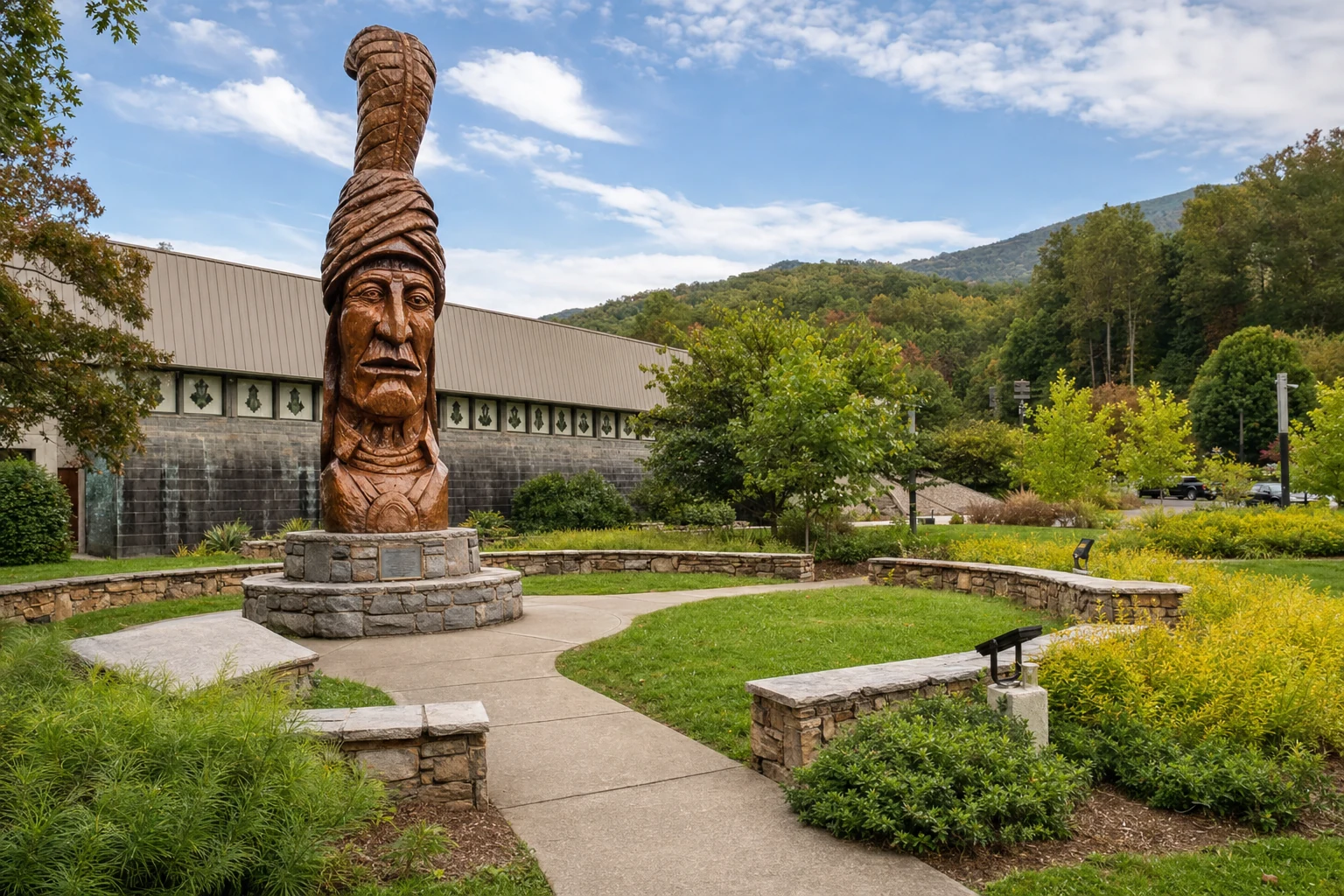
Cherokee culture in the Smokies is the living culture of the Eastern Band of Cherokee Indians, whose sovereign homeland, the roughly 57,000-acre Qualla Boundary, borders the national park. Start at the Museum of the Cherokee People (open daily, 9 a.m. to 5 p.m.), then visit the Oconaluftee Indian Village (April to October), Qualla Arts and Crafts Mutual and, in summer, Unto These Hills.
The Great Smoky Mountains are the ancestral homeland of the Cherokee people, and you are a guest in Cherokee country. The Cherokee are not a historical exhibit. The Eastern Band is a modern nation of roughly 16,000 enrolled members, governed by its own Tribal Council and Principal Chief, with its own schools, hospital, courts, businesses and cultural institutions. What follows is a starting point for visiting in an informed and respectful way. For the town itself, see our Cherokee, NC guide.
Where should you start learning about Cherokee culture?
Museum of the Cherokee People. The anchor of any visit. The museum was founded in 1948 and renamed in October 2023 (it was formerly the Museum of the Cherokee Indian). It tells the Cherokee story from earliest times through removal and the present day, in the Cherokee community's own voice. It is open seven days a week from 9 a.m. to 5 p.m., with the last ticket sold at 4 p.m., and closes on a few holidays, including Thanksgiving and Christmas. Plan at least two hours, and check the museum's visit page for current admission and holiday closures.
Qualla Arts and Crafts Mutual. Founded in 1946, Qualla Arts and Crafts Mutual describes itself as the nation's oldest and foremost Native American cooperative. Cherokee artists sell baskets, pottery, carvings, beadwork and other handmade work here. The store is at 645 Tsali Boulevard in Cherokee and keeps shorter hours in winter, so check before you go. Buying here supports the makers directly.
Oconaluftee Indian Village. A living-history recreation of an 18th-century Cherokee village, run by the Cherokee Historical Association. Guided tours show basket weaving, pottery, blowgun making and cooking. In 2026 the guided season ran from April 21 to October 31, with the village closed Sundays; the association has said self-guided visits return in November. Confirm current dates on the Cherokee Historical Association site.
When does Unto These Hills run?
Unto These Hills is an outdoor drama about Cherokee history, including the Trail of Tears, performed at Mountainside Theatre in Cherokee since 1950. It is a summer show. The 2026 season ran from May 30 to August 22, Monday through Saturday, so it is not running now, and 2027 tickets are expected to go on sale in mid-November. Check the Cherokee Historical Association for the 2027 schedule.
What else is worth visiting?
Kituwah Mound. Kituwah, near Bryson City, is the Cherokee's ancient mother town and a sacred site. It returned to the Eastern Band in 1996. Approach it with the gravity you would bring to any sacred place, and ask the tribe about visitor guidance.
Sequoyah Birthplace Museum. Across the Tennessee line at Vonore, this museum is dedicated to Sequoyah, the Cherokee scholar who created the syllabary in the 1820s, a feat that is often described as nearly unique in history.
The Oconaluftee area of the national park. The park's Oconaluftee Visitor Center and Mountain Farm Museum, a few minutes from Cherokee, show how Appalachian settlers lived on land the Cherokee had long inhabited. See our elk-watching guide for the fields beside them.
What is the Cherokee language?
Tsalagi, the Cherokee language, is a Southern Iroquoian language. It has been written since Sequoyah created his syllabary in the 1820s, an 85-character script that lets Cherokee be written phonetically. Fluent first-language speakers are few, and the Eastern Band runs immersion programs, including the New Kituwah Academy, to keep the language alive. You will see Cherokee syllabary signs alongside English around the Qualla Boundary. Basic words visitors often learn include:
- siyo (hello)
- wado (thank you)
What was the Trail of Tears?
In 1838 and 1839 the U.S. government forced roughly 16,000 Cherokee people from their southeastern homelands to Indian Territory, in present-day Oklahoma, and about 4,000 died along the way. The Eastern Band descends from Cherokee who avoided removal, including those who hid in the mountains and those who were legally allowed to stay. The story is told with full weight at the Museum of the Cherokee People and in Unto These Hills. Come prepared emotionally, because this is not sanitized history.
What is Cherokee like today?
Cherokee has a diverse modern economy. Harrah's Cherokee Casino Resort is a major employer and revenue source, and the tribe also operates its own hospital, schools and enterprises. The Eastern Band is governed by an elected Principal Chief, Vice Chief and Tribal Council. Mostly, though, Cherokee is a small working town where people live ordinary lives, so treat it that way. Do not photograph residents without permission, and do not assume everyone you meet is an artisan or a storyteller. Many are simply running errands.
How can you visit respectfully?
- Use the right name. The government is the Eastern Band of Cherokee Indians (EBCI), and the people are Cherokee. The land is called the Qualla Boundary.
- Ask before photographing people, even in public places.
- Buy handmade crafts from Qualla Arts and Crafts Mutual or from named Cherokee artists, and be cautious of souvenirs that do not say who made them.
- Visit the museum early in your trip, because everything else makes more sense afterward.
- Treat sacred sites such as Kituwah with respect.
- Support tribal-member-owned businesses.
- At cultural events, follow the lead of tribal members on photography, recording and applause.
- Avoid Plains-style imagery such as tipis. Historically, the Cherokee lived in log and clay-daub houses and met in council houses.
What is happening in Cherokee this winter?
The 2026-27 holiday season brings Cherokee Winterfest on Oconaluftee Island (November 27 to December 31), the Enchanted Island of Lights (November 27 to January 2) and the Cherokee Christmas Parade, typically the second Saturday of December. The museum stays open year-round. See the Smokies events calendar and the tribe's visitor site for current dates.
Why was Clingmans Dome renamed Kuwohi?
Clingmans Dome, the highest peak in the Smokies at 6,643 feet, was officially renamed Kuwohi in 2024. Kuwohi is its Cherokee name, meaning "mulberry place," and the change restores a name used long before European settlers arrived. The Park Service now uses Kuwohi, and its road, parking area and visitor center follow suit. In 2026 Kuwohi Road is open from April 1 to November 29, weather permitting. See the national park guide and the Newfound Gap guide.
Further reading
Before you visit, consider these sources:
- The Museum of the Cherokee People's website and exhibit resources
- Ellen Cushman, "The Cherokee Syllabary: Writing the People's Perseverance"
- The Cherokee Historical Association and the tribe's own publications