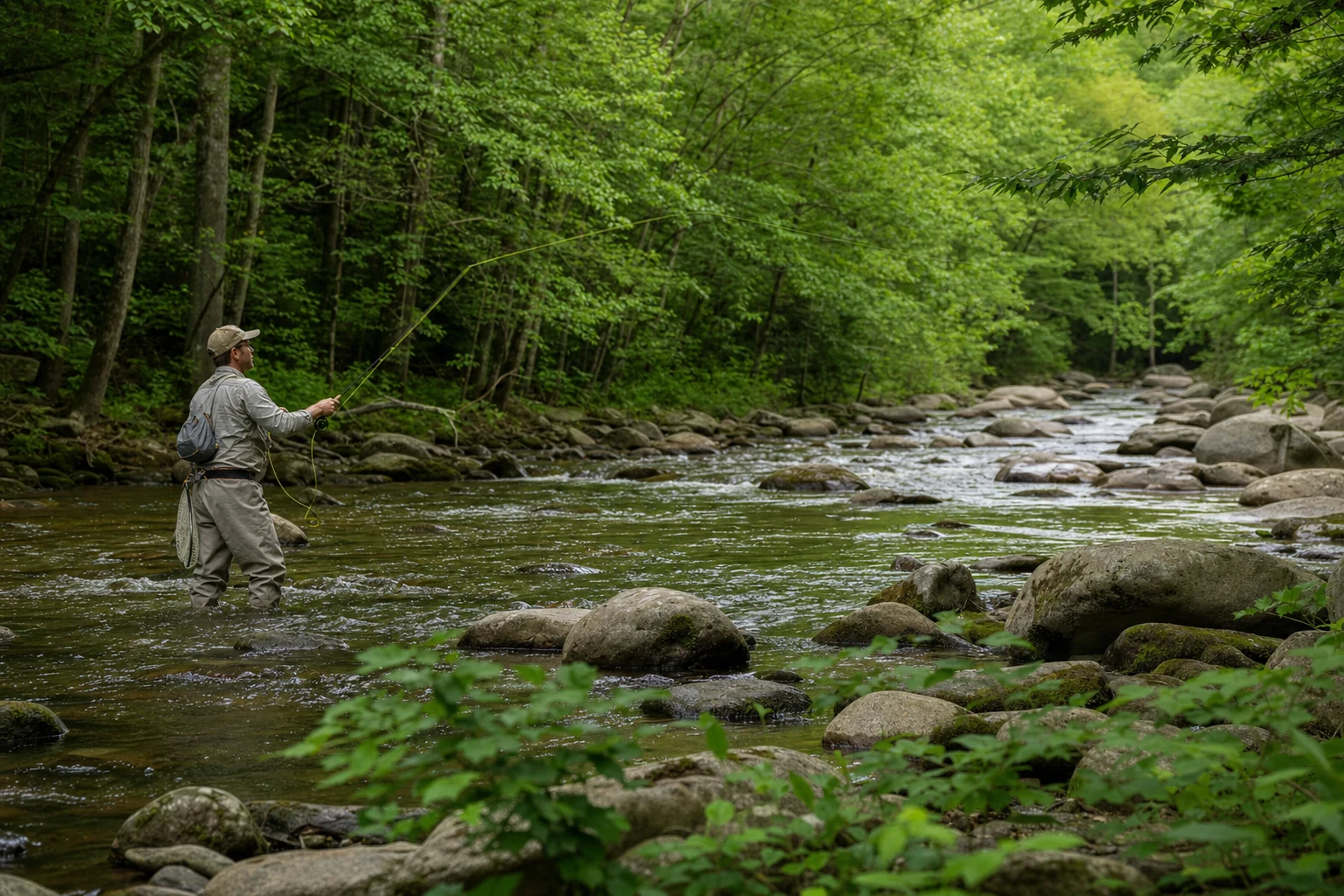
Fly fishing in the Smokies is best in spring and fall, on streams like the Little River, Abrams Creek, Deep Creek and the Oconaluftee, using single-hook artificial flies and either a Tennessee or North Carolina fishing license (no trout stamp needed). The park has about 2,900 miles of streams, rainbow, brown and native brook trout, and no closed season. A guide on your first day shortens the learning curve a lot.
The Smokies hold one of the richest concentrations of trout water in the eastern United States, and the system is managed to protect native populations. For fly fishers, the region ranks alongside the Catskills and the Driftless as a home water.
What fish live in the Smokies?
Rainbow trout (non-native but naturalized since the early 1900s) are the most abundant: aggressive, sporting, and usually 10 to 14 inches.
Brown trout (also non-native) are larger and warier, with 14 to 20 inches possible in bigger streams. Dawn and dusk fish best.
Appalachian brook trout (native, the "specks") were pushed to high-elevation headwaters by the non-natives. They are small (6 to 10 inches) and beautifully colored, and they are the only native trout in the park. The minimum length is 7 inches, and anything smaller must go back immediately. Handle them gently, and read the rules on the Park Service fishing page.
Where should you fish in the Smokies?
Little River (Tennessee side): the classic fishery, with public access at Metcalf Bottoms, Elkmont and along Little River Road. See Townsend for lodging and outfitters.
Abrams Creek (Cades Cove): a limestone-influenced creek where trout run larger. Parking fills fast in season.
Oconaluftee River (North Carolina): accessible from Cherokee up to high headwaters.
Deep Creek (North Carolina): excellent public access a short drive from Bryson City.
Hazel Creek (North Carolina): remote backcountry water reached by boat across Fontana Lake or a long hike. Check trail and access conditions first, since Hurricane Helene damaged parts of the North Carolina backcountry.
Noland Creek, Forney Creek and Eagle Creek: lesser-known backcountry streams with less pressure and good native brook trout fishing.
Do you need a fishing license in the Smokies?
Yes, if you are 16 or older. A valid Tennessee or North Carolina fishing license is accepted anywhere in the park, and no trout stamp is required. Licenses are not sold in the park, so buy one online from the Tennessee Wildlife Resources Agency or the North Carolina Wildlife Resources Commission, or at a local outfitter. Prices change, so check the agency site. Fishing inside the Gatlinburg and Cherokee town limits requires special local permits.
What are the fishing regulations?
- Season and hours: open year-round, from 30 minutes before sunrise to 30 minutes after sunset.
- Tackle: one hand-held rod, and only artificial flies or lures with a single hook. Up to two flies per leader is allowed. No bait of any kind, and no double, treble or gang hooks.
- Limits: five trout or smallmouth bass per day in any combination, including brook trout, with a 7-inch minimum length.
- Inspections: rangers may check your tackle and creel.
Which guides and fly shops are in the area?
Tennessee side: Little River Outfitters in Townsend is a long-running full-service shop with guides. Several other outfitters operate out of Gatlinburg and Townsend.
North Carolina side: the Nantahala River and Bryson City areas have fly shops and guides. Hunter Banks in Asheville covers the whole region.
Guided half-day and full-day wade trips are the best way to learn local hatches, stream reading and access. Ask for current rates when you book, since they vary by season and trip type. Most guides supply gear and flies, and you supply your license, boots and willingness.
When is the best season for fly fishing?
Spring (March to May): strong water from snowmelt and active feeding. The best all-around season.
Summer (June to August): warmer water, so fish early and late. High-elevation brook trout water stays cool and productive.
Fall (September to November): prime time, with aggressive pre-winter feeding and cooler water. October is often the best fishing of the year.
Winter (December to February): quieter, with slower and deeper fish, but great solitude.
Which flies work in the Smokies?
- Dry flies: Elk Hair Caddis, Adams, blue-winged olive, Stimulators
- Nymphs: Pheasant Tail, Hare's Ear, Copper John
- Streamers: Woolly Bugger and sculpin patterns
- Terrestrials (summer): ants, beetles, hoppers
Local fly shops sell boxes tuned to current Smokies hatches, so buy local.
What is fishing etiquette?
- Stay out of other anglers' pools. If someone is working a pool, move 100 yards or more upstream.
- Release fish properly: wet your hands, support the fish in the water, and minimize air exposure.
- Park only in designated pullouts and do not block trailheads. Remember that parking longer than 15 minutes needs a park tag ($5 daily, $15 weekly, $40 annual; federal passes are not accepted).
- Report violations, such as live-bait use, to a ranger.
What gear do you need for a first Smokies trip?
A 9-foot, 4- or 5-weight fly rod with reel and line, a 9-foot 5X tapered leader, a handful of flies in sizes 12 to 16, waders and boots (or wet-wading in summer), a net, and your license. For occasional anglers, a guided day is often better value than buying everything.
What events are there for anglers?
The Maggie Valley Fly Fishing and Outdoor Festival is scheduled for May 28 and 29, 2027, and the Opening Day Trout Fishing Tournament on Cherokee's Qualla Boundary waters is held in late March. See the events calendar for dates.
What about Hazel Creek?
Hazel Creek is the legendary Smokies backcountry fishery. It is reached only by boat across Fontana Lake or by a long hike, with old homesites and mill ruins along the creek and some excellent native trout water. You need a backcountry permit for overnight stays (sold on recreation.gov at $8 per person per night), bear-safe food storage and a light rod.