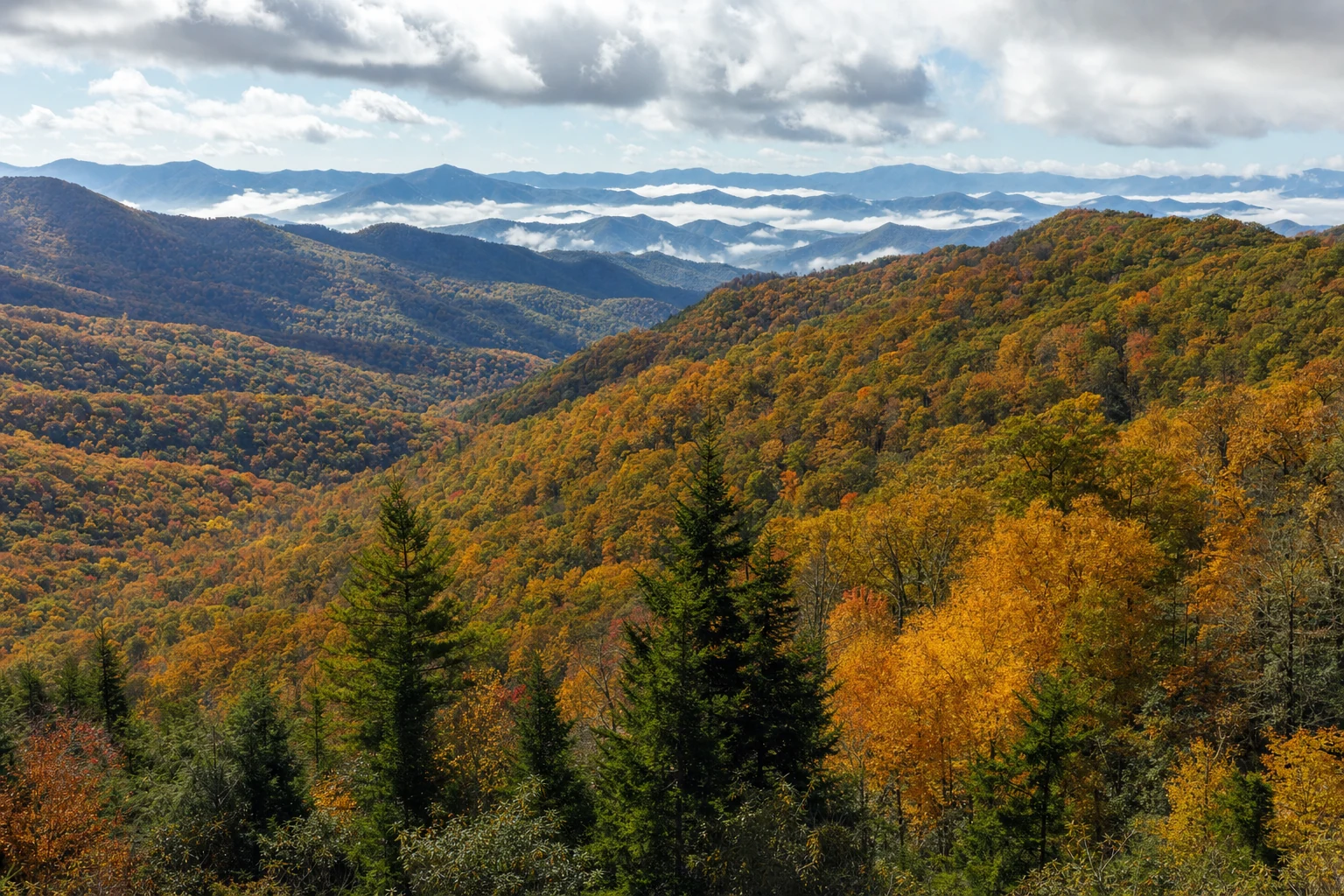

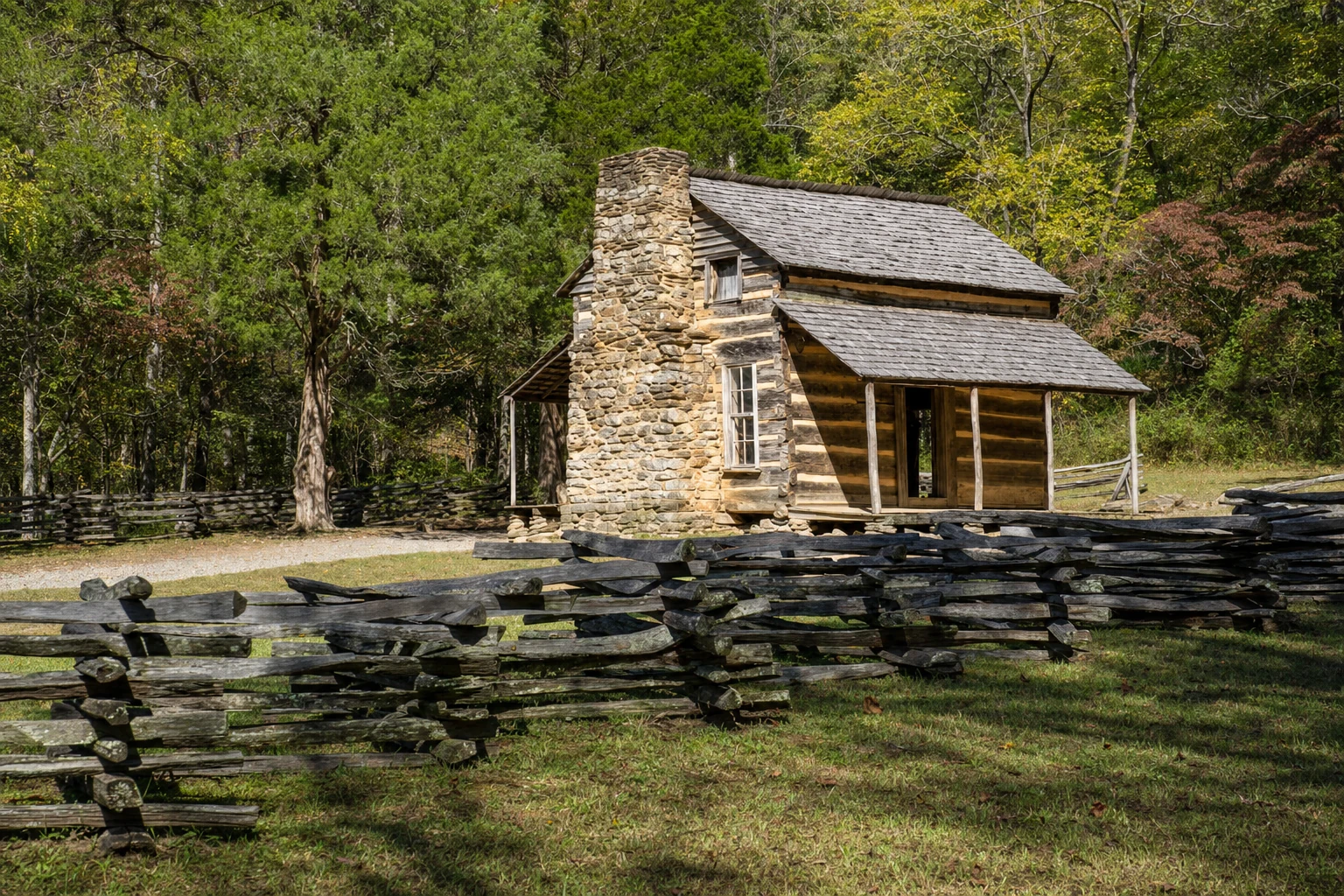
The Cades Cove Loop is an 11-mile, one-way road around a broad, flat valley on the Tennessee side of Great Smoky Mountains National Park. It is open from sunrise to sunset every day, closes to cars on Wednesdays from early May through late September (May 6 to September 30 in 2026), and takes two to four hours when traffic is light and five or more on a busy fall weekend. You get log cabins, three churches, a working grist mill and the park's best odds of seeing deer and bears from the road.
Come early, bring snacks, and treat the loop as a slow tour, not a quick drive. The reward is one of the best-preserved 19th-century Appalachian landscapes in the East: open fields ringed by peaks, with cantilever barns and weathered cemeteries at the edges.
How long does the Cades Cove Loop take?
Plan on two hours with almost no stops, which is realistic only on a quiet weekday morning. With stops at the cabins and the mill, three to four hours is normal. On summer and October weekends, one stopped car watching a bear can back traffic up for a mile, and the loop can take five hours or more. There is no turnaround, so once you are in, you are in. Two shortcut roads, Sparks Lane and Hyatt Lane, cut across the middle of the valley if you need to bail out early.
The best fixes are simple. Enter at sunrise, go on a weekday, or pick a Wednesday vehicle-free day and ride a bike.
What are the vehicle-free Wednesdays?
From early May through late September, the loop road is closed to motor vehicles all day on Wednesdays, and only cyclists and walkers can use it. In 2026 that meant every Wednesday from May 6 through September 30. Class 1 and Class 2 e-bikes are allowed; scooters and skateboards are not, and the speed limit is 20 mph. Parking at the entrance is limited, so arrive in the afternoon or early if you plan to ride. Bike rentals are available near the loop entrance. The 2027 dates are usually announced in April on the National Park Service vehicle-free days page. Saturday mornings are not vehicle-free, and nothing else closes the loop on a regular schedule.
The preservation story
Great Smoky Mountains was assembled by buying thousands of private tracts, with money from Tennessee, North Carolina, and a $5 million gift from the Rockefeller family. For the families in Cades Cove, the park's creation in the 1930s meant selling and leaving. At its peak in the mid-19th century the Cove held more than 600 people, with its own churches, mills and schools.
A few residents negotiated lifetime leases. The most famous were the Walker Sisters, five unmarried sisters who kept their Little Greenbrier homestead, farming, spinning and weaving the old way, until the last of them died in 1964. Their cabin sits outside the Cove proper, but their story explains why the buildings you see today were kept.
What do you see mile by mile around the loop?
The entrance drops you straight into open pasture framed by the crest of the Smokies. The loop is paved the whole way and the grade is gentle. Mileages are approximate.
- Mile 0.2: John Oliver Cabin. One of the oldest structures in the park, built in the early 1820s. A short level walk from a small pullout, and worth stepping inside for the scale of early pioneer life.
- Mile 2.0: Primitive Baptist Church. Established in 1827. Plain clapboard, a plain interior and a cemetery of weathered headstones.
- Mile 2.8: Methodist Church. The current building dates to 1902. The interior is slightly more ornate than its Baptist neighbor.
- Mile 3.3: Missionary Baptist Church. The congregation split from the Primitive Baptists in 1839 over whether to support missionary work; the present building dates to 1915. Seeing all three back to back is a quick course in frontier religion.
- Mile 5.0: Abrams Falls trailhead. A five-mile round trip along Abrams Creek, rated moderate. The falls are only about 20 feet tall but push a lot of water into a deep pool. Allow three to four hours and wear sturdy shoes. Swimming at the base is dangerous.
- Mile 5.5: Cades Cove Visitor Center and Cable Mill. The halfway point. Restrooms, a bookstore and exhibits. The Cable Mill historic area, with the mill, a barn, smokehouse, blacksmith shop and the Becky Cable House, is open daily from March 15 to November 29, 2026, 9 a.m. to 5 p.m. Peak-season staff sometimes run the mill.
- Henry Whitehead Place. Built in 1898, with a large log cabin and a cantilever barn, the Appalachian design where the upper story overhangs the foundation to shelter livestock and hay.
- Dan Lawson Place. Built in 1856 with a mix of log and frame, a sign of both new building techniques and some prosperity. Lawson farmed, worked as a blacksmith and made barrels.
- Tipton Place. Built in the 1870s: a two-story log house, cantilever barn, blacksmith shop and a still house, which hints at the role of moonshine in Cove economics.
- Carter Shields Cabin. A small log cabin from the 1880s built for a Civil War veteran, often ringed by wildflowers in late spring and one of the most photographed buildings on the loop.
Two one-way gravel roads leave the loop toward Townsend: Rich Mountain Road (open April 10 to November 9 in 2026) and Parson Branch Road (May 1 to November 9, eight miles, high-clearance vehicles recommended). Both are narrow, and conditions change after storms, so check the park's seasonal road schedule before committing. The trailhead for Gregory Bald, famous for flame azaleas in late June, is reached by Forge Creek Road near the Cable Mill (open March 6 to December 31 in 2026).
Where do you see wildlife in Cades Cove?
The open fields make this the best place in the park to see large animals from the road.
- White-tailed deer graze in the fields at dawn and dusk. A sunrise loop almost guarantees them.
- Black bears are the headline draw. Dawn and dusk give the best odds, with spring (mothers and cubs) and fall (bears fattening up before denning) as the peak seasons. Stay at least 50 yards (150 feet) from bears, never feed them and never block a bear's path.
- Coyotes show up at dawn and dusk in the fields, alone or in pairs.
- Wild turkeys work the forest edges and strut in the fields in spring.
- Bobcats live here but are rarely seen.
The first hour after sunrise and the last hour before sunset are best for animals and for photography, and traffic is lightest then. If you want elk instead, head to Cataloochee Valley or the Oconaluftee fields.
Do you need a parking tag in Cades Cove?
Yes. Entering the park is free, but any vehicle parked longer than 15 minutes anywhere in Great Smoky Mountains National Park, including every Cades Cove pullout and the Abrams Falls lot, needs a parking tag: $5 a day, $15 a week or $40 a year. The tag must be displayed physically (no digital copies), and America the Beautiful and other federal passes are not accepted in place of it. Buy online at recreation.gov, at a visitor center or at the card machines at the larger lots. Rangers check, especially in fall.
Photographing the loop
Cades Cove rewards patience with weather. Midday blue sky makes the churches and cabins look like postcards, but morning fog settling into the valley after a cool, clear night is the shot people travel for. Put the John Oliver Cabin or the Carter Shields Cabin in front of mist and you have the classic Smokies photograph. Golden hour at the Cable Mill, with low light through the millrace, gives the cleanest version of that scene. For wildlife, a 300mm lens keeps you at a legal distance while still filling the frame.
How do you plan the day?
Be at the loop entrance by 7 a.m. if you want smooth passage; by 9 on a summer or fall weekend, traffic can crawl. Pack lunch for the Cades Cove Picnic Area near the loop entrance, or picnic at the visitor center halfway around. Expect little or no cell service, so download maps offline. Restrooms are limited, so use them at the entrance area and the visitor center. Commercial tours from Gatlinburg and Townsend run in peak season and are the easiest option if you want the history and wildlife without driving.
When is the best time to visit Cades Cove?
- Late spring (late April to May): dogwoods and wildflowers line the loop, fields turn green and cubs follow their mothers through the grass.
- Summer (June to August): warm and humid, with wildlife best at the bookends of the day. Wednesday bike mornings are at their peak.
- Early fall (late September to early October): cooler air, lighter crowds and the first color on the surrounding ridges.
- Peak fall (mid to late October): the most photographed and the busiest stretch of the year. Skip weekends and go on a Tuesday or Thursday.
- Winter (December to February): the loop stays open, the fields are bare and deer stand out against the empty landscape. Snow or ice can close the road without notice.
A first visit deserves a full day: enter at dawn, finish one loop, eat at the picnic area and take a second slow lap in the afternoon.