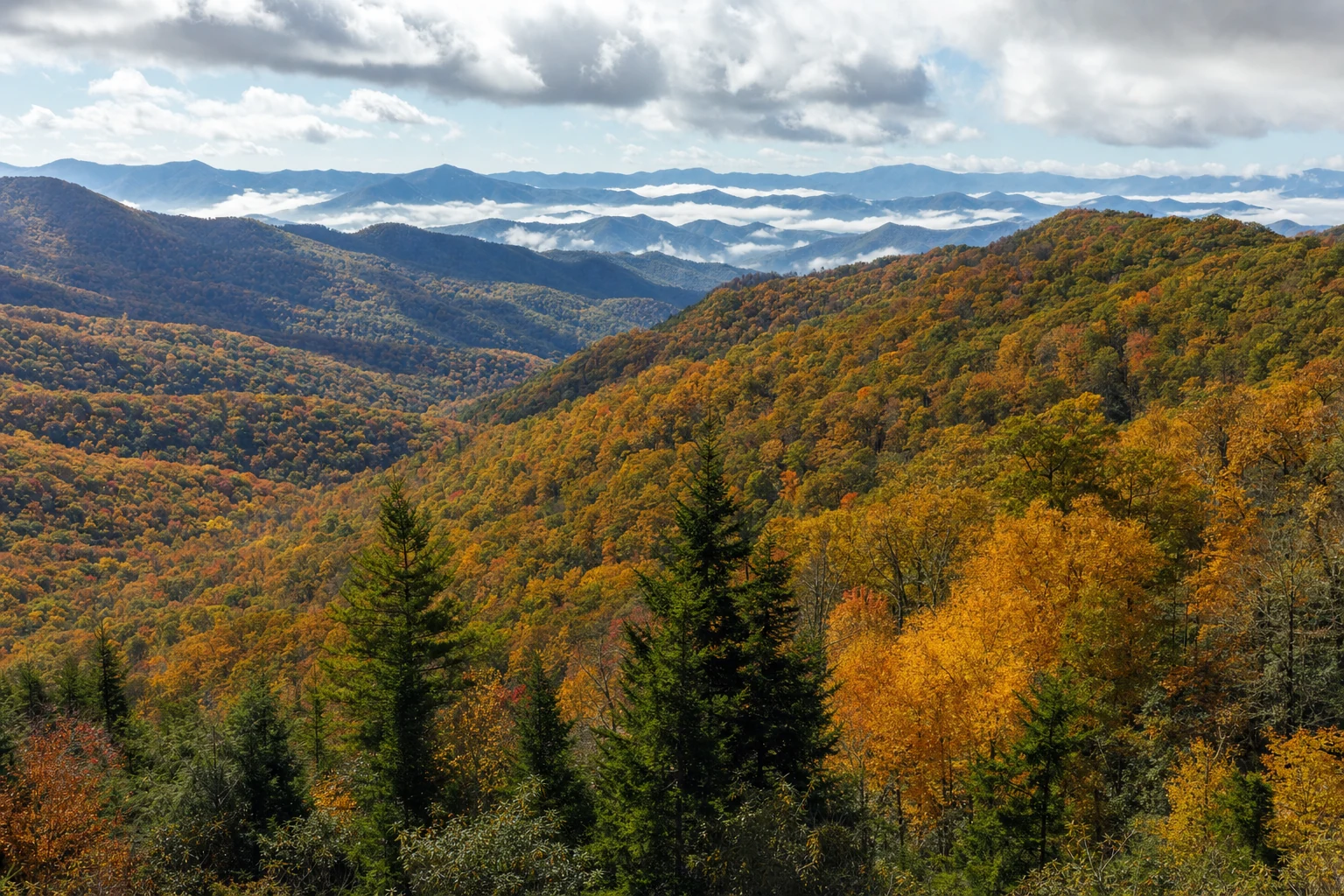

Cataloochee Valley is the most rewarding place in Great Smoky Mountains National Park that most visitors never reach. Tucked into the remote southeastern corner of the park on the North Carolina side, it is the best elk-viewing destination in the eastern United States, a preserved Appalachian community of historic homesteads, and a trailhead into some of the last substantial old-growth forest in the region. The access road filters the crowds — narrow, winding gravel with steep drop-offs — and the reward for persistence is a valley that feels like the Smokies before tourism reached them. This is the deep guide: how to get there, what to do, when to go, and what everyone confuses it with.
Getting in — the road is the filter
The drive is the first thing to understand. The main access from the east is Cove Creek Road, branching off NC-276 near Jonathan Creek, just south of I-40. The first stretch of NC-276 is paved and ordinary. Cove Creek Road then turns into a narrow, winding, gravel-and-dirt surface. Once inside the park boundary it becomes Cataloochee Road. The full access corridor is characterized by steep grades, sharp blind curves, significant drop-offs, and limited or no guardrails. Not recommended for large RVs, trailers, or drivers uncomfortable with mountain roads. Drive in daylight if possible.
- From Maggie Valley — approximately 45 to 60 minutes, covering 15 to 20 miles, depending on road conditions and traffic.
- From Cherokee — approximately 1 hour 15 minutes to 1 hour 30 minutes, covering 35 to 40 miles via US-19 N, I-40 E, NC-276 S, then Cove Creek Road.
Before descending into the valley floor, the road passes the Cataloochee Valley Overlook, a critical stop offering panoramic views of the valley below. Pull off, look, and use the pause to mentally prepare for the final descent. Cell service is unreliable or non-existent on Cove Creek Road and throughout the valley — download offline maps before leaving Maggie Valley or Cherokee. GPS occasionally routes people onto the Cataloochee Ski Area (an entirely different place — see below), so confirm the destination is set to "Cataloochee Valley, Great Smoky Mountains National Park" before pulling away.
The elk — why most people come
Cataloochee's thriving elk herd is the headline draw. Elk were reintroduced to Great Smoky Mountains National Park in 2001, and they have flourished here. The open fields on the valley floor give them prime grazing, and the timbered slopes provide cover. Today, Cataloochee is the premier elk viewing destination in the eastern United States — both for the density of animals and for the openness of the terrain that makes spotting them straightforward.
The spectacle peaks during the rut — the breeding season — in September and October. Large bull elk perform dominance displays: bugling across the fields (the sound carries extraordinary distances in the valley's acoustic shape), sparring with antlers, and herding harems of cows. Dawn and dusk are the active periods; midday tends to be quiet. Binoculars or a spotting scope dramatically improve the experience — the distance rules mean the naked eye is sometimes pressed.
Elk are visible year-round, but the rut brings the drama. Spring calving season in late May into June offers a quieter but equally rewarding experience as cow elk appear with calves.
Viewing rules — non-negotiable
The park enforces a strict minimum distance of 150 feet (45 meters) from all elk, at all times. This is not a suggestion.
- Elk, especially bulls during the rut, can be unpredictable and aggressive. Charges have injured visitors who approached too closely.
- Rangers are frequently present during peak viewing seasons and will cite violators. Fines are significant.
- Never feed wildlife. Human habituation creates dangerous animals that eventually have to be destroyed.
- Stay on roads and pullouts when viewing from near the fields. Do not walk into the open meadows when elk are present.
The 150-foot rule applies to photography as well. A long lens is not optional if you want frame-filling shots — bring at least 300mm equivalent, longer if possible.
The preserved community — a living historical record
Before the park, Cataloochee Valley was home to roughly 1,200 people in the early 20th century, one of the largest Appalachian mountain communities of its era. When the park was established in the 1930s, homesteads were acquired and most structures demolished. A handful were preserved, and they remain one of the best-maintained collections of pre-park Appalachian architecture in the Smokies.
- Palmer Chapel — a white-frame church built in 1898, still occasionally used for services and reunions. A frequent photography subject, especially in autumn light.
- Caldwell House — a two-story frame house built around 1903, representing a more prosperous homestead. Finer carpentry than most structures of the era.
- Beech Grove School — a one-room schoolhouse dating to 1901, offering tangible insight into rural mountain education.
- Palmer House — a significant residence with outbuildings, giving a sense of daily homestead life.
- Woody Cabin — a smaller, more rustic log cabin showing simpler living conditions.
- Messer Barn — a large, iconic cantilever barn, the distinctive Appalachian architectural style, built by the Messer family. The cantilever construction (a log crib with an overhanging upper loft) was developed by East Tennessee farmers in the late 1800s.
- Steve Woody House — another well-preserved home deeper in the valley, reached via a short walk.
Exteriors are accessible year-round. Interiors may open for specific ranger-led programs or special events. Informational plaques at each site provide historical context. The Palmer Chapel is often the emotional anchor of a Cataloochee visit — walking through it with the valley spread behind you compresses a century of mountain history into a single stop.
The trails — old-growth forest and backcountry access
Cataloochee's trail network is a major part of what makes the valley worth the drive, not just a drive-through wildlife stop.
- Boogerman Loop (7.4 miles, strenuous) — the classic. A loop through magnificent old-growth forest that escaped the logging era. Towering tulip poplars, hemlocks, and hardwoods. Multiple stream crossings. Feels genuinely wild. Named for Robert "Boogerman" Palmer, who reportedly refused to let loggers touch his land — the reason the grove still stands.
- Little Cataloochee Trail — leads to the remote Little Cataloochee Baptist Church, another historic structure tucked into a more secluded section of the valley. The trail passes old homestead sites and is a journey through history as much as through forest. Quieter and more reflective than Boogerman.
- Pretty Hollow Gap Trail — a connector to other backcountry routes, useful for planning longer loops into the surrounding wilderness.
- Rough Fork Trail — deeper wilderness access, connecting with Boogerman Loop and other routes.
- Mt. Sterling Trail — accessible from the Cataloochee region, with a fire tower summit offering expansive views. Significant climb, often part of multi-day backpacking trips.
Water crossings on several of these trails can be tricky after heavy rain. Check conditions before you commit to a full loop.
Cataloochee Campground — sleeping inside the valley
Cataloochee Campground is the overnight option inside the valley, and it transforms the experience. Camping here means you are on site for the dawn and dusk elk viewing windows without the drive up and down Cove Creek Road in the dark.
- Sites — tent and RV sites available; no hookups (no electrical, water, or sewer at sites)
- Amenities — flush toilets, potable water, picnic tables, fire rings; no showers
- Reservations — mandatory, via Recreation.gov
- Season — typically early April through late October; specific dates vary annually
- Popularity — high, especially during the September-October rut; book months ahead
Given the campground's modest size and the intensity of rut-season demand, serious visitors set reservation alerts and book the moment windows open on Recreation.gov.
The winter reality — access closes
Cove Creek Road / Cataloochee Road typically closes from November through March or April due to snow and ice. The valley is effectively inaccessible by vehicle during these months. Intrepid hikers and backpackers can reach it on foot via longer routes, but the typical visitor drive is not an option.
Anyone planning a late fall, winter, or early spring trip must verify road status directly with GSMNP before departure. Conditions can close the road earlier than typical or keep it closed later into spring. The NPS updates road conditions on its website and at visitor centers.
Park-It-Forward and Kuwohi
Since March 2023, all visitors to GSMNP — including Cataloochee — must display a valid Park-It-Forward parking tag for any vehicle parked longer than 15 minutes. This applies at trailheads, overlooks, and the campground. Tags cost $5 daily, $15 weekly, $40 annual, available online via Recreation.gov or at park physical locations. Enforcement is active.
In September 2024, the peak formerly known as Clingmans Dome was officially renamed Kuwohi, honoring the ancestral language of the Eastern Band of Cherokee Indians and the Cherokee name meaning "Mulberry Place." While not in Cataloochee itself, the renaming reflects the park's ongoing recognition of indigenous heritage that shaped the broader region.
Cataloochee Valley is NOT the Cataloochee Ski Area
This is the single most common point of confusion, and it regularly sends visitors to the wrong place. Cataloochee Valley is the wilderness valley inside Great Smoky Mountains National Park described above — elk, historic homesteads, gravel road access, no ski lifts. Cataloochee Ski Area is a privately operated ski resort located at 7000 Soco Road in Maggie Valley, NC, a completely different place offering skiing, snowboarding, and snow tubing in winter.
They share the Cataloochee name and are geographically close — Maggie Valley is the jumping-off point for the drive to Cataloochee Valley — but they are entirely different destinations. Set GPS navigation specifically to "Cataloochee Valley, Great Smoky Mountains National Park" to avoid the most frequent mistake travelers make approaching this area.
What to bring and how to plan
Because of the remoteness, plan to be self-sufficient for the duration of the visit.
- Water, snacks, and a full meal if staying half a day or more — no food service inside the valley
- Bug spray in warmer months — mosquitoes and ticks are real
- Binoculars or a spotting scope — dramatically improves elk viewing
- Telephoto lens (300mm+) if serious about wildlife photography
- Paper map or offline digital map — cell service drops well before you reach the valley
- Full fuel tank leaving Maggie Valley — no gas inside the park on this side
- Layered clothing — valley is cooler than lowlands, and rut season mornings can be cold
- Patience — elk appear when elk appear; the best viewing is often first or last light
Respect for wildlife, Leave No Trace principles, and adherence to park regulations are what keep Cataloochee Valley the way it is. The valley's wildness is preserved by every visitor who pauses at 150 feet, drives the road carefully, and leaves the place as they found it.