
Johnson City is about 105 miles from Gatlinburg, roughly 1 hour 50 minutes by way of I-26, I-81 and I-40. It is one of the nearer launch points for the Smokies in northeast Tennessee, a workable day trip, and the route does not use the Pigeon River Gorge section of I-40 in North Carolina at all.
What is the best route from Johnson City to Gatlinburg?
Head west on I-26 to I-81, follow I-81 South to I-40, then go west on I-40 to exit 407 at Sevierville. TN-66 and US-441 South carry you through Sevierville and Pigeon Forge into Gatlinburg. The interstate miles move quickly and US-441 is where schedules fall apart: summer Saturdays can add 20 to 40 minutes through the Pigeon Forge strip, and leaving before 8 a.m. sidesteps most of it. October weekends during fall color are the other problem, and there is no real shortcut.
To skip Pigeon Forge, leave I-40 at exit 432 in Newport and take US-321 South through Cosby into Gatlinburg.
Is a day trip from Johnson City to the Smokies realistic?
Yes. Leave by 7 a.m. and you can be on a trail by 9, with time to hike, eat lunch in Gatlinburg and still drive home. A single destination works best, such as a morning hike and a few hours in Gatlinburg.
Two nights makes more sense if you want both sides of the park. Cades Cove is an 11-mile loop best at dawn, and Cataloochee Valley on the North Carolina side is a long drive from Gatlinburg. A week suits people who want to combine Dollywood, several trails, shows in Pigeon Forge and time in Cherokee and Bryson City.
What to do when you arrive
For a first hike, Alum Cave Trail (4.4 miles round trip to Alum Cave Bluffs) is the best moderate hike on the Tennessee side. Grotto Falls (2.6 miles round trip from the trailhead on the Roaring Fork Motor Nature Trail) is the one waterfall where the trail walks behind the falls, and Abrams Falls (about 5 miles round trip from Cades Cove) ends at a wide, powerful drop into a deep pool.
One warning before you pick a waterfall: Laurel Falls Trail has been closed since January 2025 and is not expected to reopen until sometime in 2027. Pick another trail for now.
Cades Cove Loop Road is 11 miles one way and opens at sunrise. On Wednesdays from early May through September (May 6 to Sept 30 in 2026) the loop is closed to cars all day and open to bicycles and walkers, which makes Wednesday the calm day to see the cove.
Kuwohi (the summit formerly called Clingmans Dome, 6,643 feet) is the park's high point. The 7-mile spur road is open April 1 to November 29 in 2026, weather permitting, and a steep half-mile paved walk leads to the observation tower.
The park has no entrance fee, but any vehicle parked longer than 15 minutes needs a parking tag: $5 for a day, $15 for a week, $40 for a year. The tag has to be displayed on the dashboard or windshield, it is tied to one license plate, and an America the Beautiful pass does not replace it. Daily and weekly tags can be bought ahead on recreation.gov (print them at home), and 24-hour machines at the bigger lots take credit cards.
Off the trail, Ripley's Aquarium of the Smokies is the standby for rainy afternoons, and Dollywood in Pigeon Forge is a full day by itself.
Where to stay
Gatlinburg is closest to the trailheads. Pigeon Forge has the most rooms, and Townsend is the quiet base for Cades Cove. Compare live rates on the map below.
When is the best time to make the trip?
Because Johnson City is close, you can pick the best day in any season, so use that flexibility.
Spring (April and early May) brings wildflowers to the lower trails and strong waterfalls with lighter crowds than summer. The famous synchronous fireflies at Elkmont are a lottery: the 2026 viewing ran May 20 to 27, applications cost $1 and a selected reservation costs $29 for one vehicle with up to seven people, and the next lottery is expected the week of April 27, 2027.
Summer is green, hot in the valleys and cool on the ridges, and the busiest stretch for traffic on the Parkway. Trailhead lots fill by 9 a.m. on weekends, so start early.
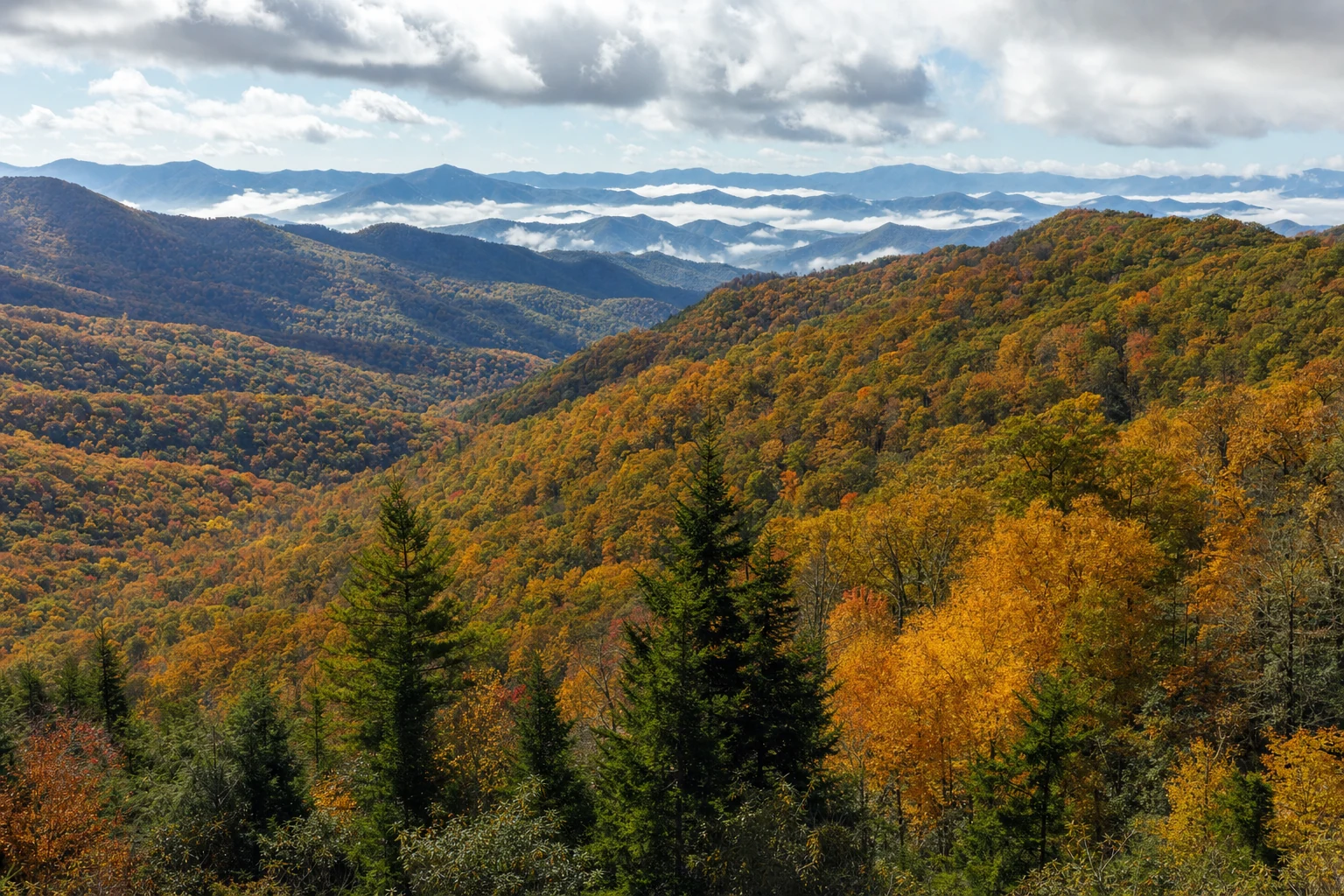
Fall is the signature season. The Park Service says color starts above 4,000 feet in mid-September and peaks there in early to mid-October, while the lower valleys peak from mid-October into early November, and October is the busiest month of the year. Book lodging months ahead and plan to arrive on a weekday or at dawn.
Winter is quiet. Newfound Gap Road closes for snow and ice with little notice, the Kuwohi road and the Roaring Fork Motor Nature Trail close for the season after November 29 in 2026, and the lower trails stay open.